
The Story Behind WERQ
How We Built a Culture People Wanted to Be Part Of
Tell me if this sounds familiar.
You've got a team. Good people, for the most part. They show up, they do the work — but somewhere underneath the day-to-day, something is off. The energy isn't there. People do what they're told and nothing more. Nobody owns the outcome the way you do. And when something goes wrong, the first instinct is to cover it, not fix it.
In many cases, it isn't a hiring problem or even a training problem. It's a culture issue. The good news is that culture can be shaped intentionally once we recognize it.
Culture must be shaped intentionally — not by default. And that's the difference.
Every company has a culture. The only question is whether you designed it or whether it just happened to you.
At Hawaiian Vacations, we made a deliberate decision early on. We were going to build a culture people actually wanted to be part of — not because it sounded good on paper, but because we believed it was the single greatest competitive advantage we had.
Looking back, I believe that decision became one of the most important contributors to our long-term success. It helped us build a business that eventually became attractive enough to be acquired by Alaska Airlines.
Culture Is Personality — And You Set the Tone

Nobody tells you this when you start a business: your company will take on your personality. Not your mission statement. Not the values you post on the wall. You, your habits, your reactions under pressure, your tolerance for mediocrity, your willingness to celebrate.
Early-stage entrepreneurial companies are basically mirrors. If you're decisive and optimistic, your team tends to be the same. If you're reactive, inconsistent, or allergic to hard conversations, that shows up, too, amplified across every person who watches how you operate every day.
What personality is your business taking on — and is it the one you'd choose?
We understood this at Hawaiian Vacations, and it shaped how we led. We wanted our culture to stand for something specific: that winning together mattered more than any individual result, that responsibility was a personal standard rather than a management tool, and that quality wasn't a product spec, it was a mindset we brought to every single guest interaction.
We didn't leave that to chance. We named it, defined it, and lived it out loud.
Culture isn't defined by a poster on the wall. It's reflected in the way people treat one another, serve customers, and make decisions when nobody is watching.
Enter WERQ — The Framework That Held Everything Together

We needed a way to take our values off the whiteboard and make them real. So, we built WERQ — our guiding principles framework, the cornerstone of everything we did at Hawaiian Vacations.
WERQ wasn't just an acronym. It was a promise we made to our team, our guests, and our community. Every hire, every decision, every customer interaction got filtered through it.
W — Win-Win
The team atmosphere at HVI was built on one core assumption: cooperation isn't optional, it's the engine. If the company succeeds, everyone wins. That philosophy extended to our guests, our vendors, and our community. And when we hit a milestone, we celebrated. We celebrated BIG: loudly, genuinely, and often.
E — Efficiency
We made a two-year, expensive, risky investment in a ground-breaking online reservations system at a time when our competitors were still taking every booking over the phone. It completely transformed how we operated. Efficiency wasn't about cutting corners; it was about using the best tools available so our team could focus on what actually mattered.
R — Responsibility
When a mistake happened, you admitted it, apologized, and fixed it, and that applied to the company just as much as to any individual. And we made sure the system was fixed so a similar mistake could not happen again. We took our financial responsibility seriously, too: to our employees, our customers, and our vendors.
Q — Quality
Our definition of a Valuable Final Product was simple and vivid: a tan, happy guest stepping off the airplane in Anchorage, ready to go back to Hawaii. That image kept its quality concrete. It wasn't a policy; it was a picture everyone on the team could hold in their mind. The future of our business depended on repeat business from delighted customers – the only way to ensure that was to deliver consistent top-quality product and service.
What would your version of a Valuable Final Product look like?
WERQ wasn't a rule book. It was a shared identity.
To see the full framework we teach — where Culture is one of six interconnected principles — watch the 6 Principles video.
One Decision That Changed the Way We Led Our Team

Our experience was that when people are given responsibility and the tools and guidelines, and were trusted to use good judgment, most rise to the occasion. When you tell someone, "We believe you're a responsible adult who cares about what we're building," something shifts. They start caring. They take ownership. They KNOW they are part of a team, and not just a number or another body. They feel they are important.
This attitude, which was part of our culture, communicated more about our values than any memo we ever wrote. It said: We believe in you. We trust your judgment. You're not a number — you're a critical part of something worth being proud of.
Are your systems telling your people you trust them — or that you're watching them?
The result was a team that showed up early, stayed late when it mattered, and gave everything to our guests not because they had to, but because the culture made them want to.
That's what a well-anchored culture actually does. It trades supervision for ownership.
Culture as Competitive Advantage

We didn't fully see this until we looked back: the culture we built at Hawaiian Vacations wasn't just good for morale. It was a strategic asset.
Great people found us. When you operate on Win-Win, trust your team and celebrate together, word gets around. We didn't have to hunt hard for talented people; they wanted to be part of what we were building.
And because they were genuinely invested in the company's success, they stayed. Low turnover sounds like a feel-good metric until you realize what it actually protects: institutional knowledge, customer relationships, and the time and money you'd otherwise spend replacing and retraining people every eighteen months.
When Alaska Airlines evaluated Hawaiian Vacations as an acquisition, they weren't just looking at revenue and routes. They were looking at the organization behind it. What they found was a team that ran well, held itself accountable, and delivered quality consistently. They found the customer loyalty that was a result of that culture. That culture added zeros to our numbers.
Is the culture you're building today something a buyer would pay a premium for tomorrow?
The culture you build today may become one of the most valuable assets your business ever creates.
Building Your Own WERQ
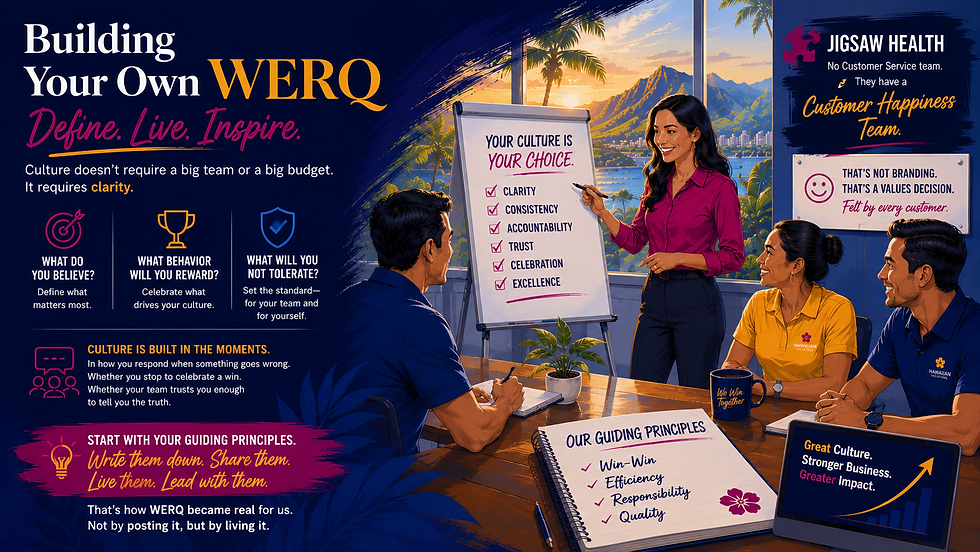
You don't need to copy our framework. You need one of your own.
Culture doesn't require a big team or a big budget. It requires clarity. What do you believe? What behavior will you reward? What will you absolutely not tolerate from your people or from yourself?
The companies that get this right share one thing in common: they made it explicit. Take Jigsaw Health, they don't have a Customer Service team; they have a Customer Happiness Team. That's not branding. That's a values decision, visible in a job title, felt by every customer who calls in. They decided what kind of company they were going to be, and they held themselves to it publicly and consistently.
Your culture is being built right now. In how you respond when something goes wrong. Whether you stop to celebrate a win. Whether your team trusts you enough to tell you the truth.
What does your culture say about you, and is it what you'd want it to say?
Start with your guiding principles. Write them down. Share them with your team. Hold yourself to them first.
That's how WERQ became real for us, not by posting it, but by living it.
This Week's Exercise: Define Your Guiding PrinciplesSet aside 20 minutes. You'll need a blank page and honest answers. Step 1: Think of two or three companies in any industry whose culture you genuinely admire. What specifically stands out? Write down the behaviors, not just the labels. Step 2: Ask yourself what two or three values are truly non-negotiable in how you operate, values you hold, whether it's convenient or not. Step 3: Draft a short statement of your Guiding Principles. It doesn't have to be an acronym. It just has to be honest, specific, and yours. Step 4: Share it with at least one person on your team this week. Watch how they respond. You're not looking for validation. You're looking for alignment or the gaps that show you where the real work begins. For a free resource to help you get started, grab it here. |
Podcast SpotlightRise & Thrive Morning with Intention Podcast with Ewa Krempa pretty much captures what I've spent 40 years chasing. We had a real conversation about what it looks like to build a business that supports your life, not one you sacrifice it for. I shared our story: how my husband and I grew our travel company from the ground up, navigated the hard seasons, and eventually sold to Alaska Airlines in 2008 — and what made walking away actually possible. We also got into why so many entrepreneurs wait far too long to ask for help. If that's you right now, this one's worth half an hour. 🎧 From Burnout to Business Freedom - Systems, Leadership & Entrepreneurial Success  |
Final Thoughts
When I look back on our years building Hawaiian Vacations, what stands out most isn't the growth or even the eventual sale to Alaska Airlines.
What stands out are the people.
It's the team members who stayed for years because they felt valued. It's the trust we built together. It's the pride people took in serving our customers and supporting one another.
WERQ gave us a common language for the culture we wanted to create, but culture was never about an acronym. It was about making intentional choices every day as leaders.
Every business has a culture, whether it is designed intentionally or develops by default. My encouragement to you is simple: decide what you want your culture to stand for, write it down, model it consistently, and invite your team to help bring it to life.
The culture you create intentionally can make a tremendous difference in the success of your business—and in the experience people have while helping you build it.
Ral West,
Livin' the Dream
Take 3 minutes to find out how much of a bottleneck you are in your own business. See the link to my Owner Diagnostic below. |
Watch our latest videos on YouTube:
Know someone who could benefit? Share this link with them!


Comments