
Staying on Course: Tools and Habits That Keep Your Goals on Track
Setting a goal is the easy part. The hard part is what happens on an ordinary Tuesday — three months later — when the excitement has faded, and the work is still there.
I want to tell you something that took me years to truly understand.
Setting a goal changes almost nothing.
I know — that sounds harsh coming from someone who teaches entrepreneurs how to grow their businesses. But stay with me.
Goals matter. Clarity matters. Vision matters enormously. But the goal itself is just a destination on a map. What actually moves you forward is what you do after you set it — the systems, the habits, the checkpoints, the people who keep you honest when momentum fades, and life gets complicated.
I've watched talented, driven entrepreneurs set powerful goals and then drift. Not because they stopped caring. Because they had no mechanism for staying on course.
When was the last time you set a goal and revisited it — not just thought about it, but actually sat down, measured your progress, and made intentional corrections?
If that question makes you wince a little, this newsletter is for you.
Part 1: Clarity Is Power — But Only If You Use It

Here is a declaration that sets the tone for everything that follows:
Clarity is Power. The more clarity you have, the more likely you are to achieve what you want. |
This is true about everything. But here's what I've learned from living it:
Clarity isn't a one-time event. You don't get clear on your destination once, write it in a journal, and coast from there. Clarity is something you must return to — regularly, deliberately, with fresh eyes — because the business changes, life changes, and the dream itself evolves.
When we started Hawaiian Vacations, we were doing everything ourselves. John had launched the business in 1982, with nothing but an idea, and it grew into a scheduled charter airline, chartering wide-body jets, flying passengers between Alaska and Hawaii. We were owner-operators in the fullest sense. We financed the company personally. We guided the marketing, made every key decision, hired and fired, and John swept the sidewalk in front of the offices himself.
We were deeply in it. And we kept telling ourselves we'd have more freedom someday.
Someday is not a destination. Someday is where dreams go to wait indefinitely.
The shift happened when we got honest about what we actually wanted — not in vague, wishful terms, but specifically. We wanted to take real vacations without the business collapsing behind us. We wanted time with our daughters. We wanted to stop having every decision go through us. We wanted to work on the business, not just in it.
That specificity — that clarity — became the north star for every decision we made afterward. And it's what I teach entrepreneurs first, because without it, all the tactics in the world are just noise.
Do you know your destination — specifically? Not 'I want to grow' or 'I want less stress.' What does success actually look like for you, for your business, for your life? Can you describe it in a sentence or two?
If you can't, that's where to start. Not with tools. Not with systems. With clarity.
Part 2: Capable Captains Make Constant Course Corrections

There's a line I use in the final module of my course that I keep coming back to, because it captures something essential:
"Capable captains make constant course corrections." |
Think about a ship navigating the open ocean. The captain doesn't set the heading on day one and then disappear below deck for the rest of the voyage. The winds shift. The currents change. Weather systems appear that weren't on the forecast. A capable captain is always looking, always adjusting, always asking: Are we still pointed where we need to go?
That is exactly what running a business requires.
Most entrepreneurs start the year — or the quarter, or the project — with a strong intention. A clear plan. Real energy. And then the daily work takes over. The fires get louder than the compass. Three months pass, and they resurface to realize they've drifted significantly from where they intended to be.
This isn't a character flaw. It's what happens when there's no mechanism for course correction built into the routine.
When something in your business isn't working — a strategy, a system, a goal — how quickly do you notice? And more importantly, how quickly do you actually adjust?
The captains who reach their destination aren't the ones who never get blown off course. They're the ones who correct fastest.
Part 3: This Is Not a 'One and Done' Project

One of the most important things I say to my students — and one of the things that surprises people most — is this:
Going through a course, building a plan, creating systems — none of it works if you only do it once.
Because the real work of building a business that gives you freedom is not a project with a finish line, it is a practice. A commitment to continual improvement that you return to again and again, for the life of your business.
At Hawaiian Vacations, we built a formal structure around this. We assembled a small advisory Board of Directors — three business leaders from completely different industries. We met with them at least twice a year, sometimes three times. Before each meeting, our department heads prepared reports: core business KPI reviews, department updates, financial analysis, and strategic planning.
Those meetings enforced an invaluable discipline. They made us stop, look up from the daily work, and assess honestly. What was working? What wasn't? Where were we headed, and was that still where we wanted to go?
The outside perspective alone was worth its weight in gold. There were moments when those advisors helped us steer in a much stronger direction than we would have chosen on our own — because we were too close to the business to see it clearly.
Who in your life is currently holding you accountable to your goals — not just encouraging you, but actually tracking your progress and asking the hard questions?
If the answer is no one, that's a gap worth closing.
Part 4: The Six-Legged Stool
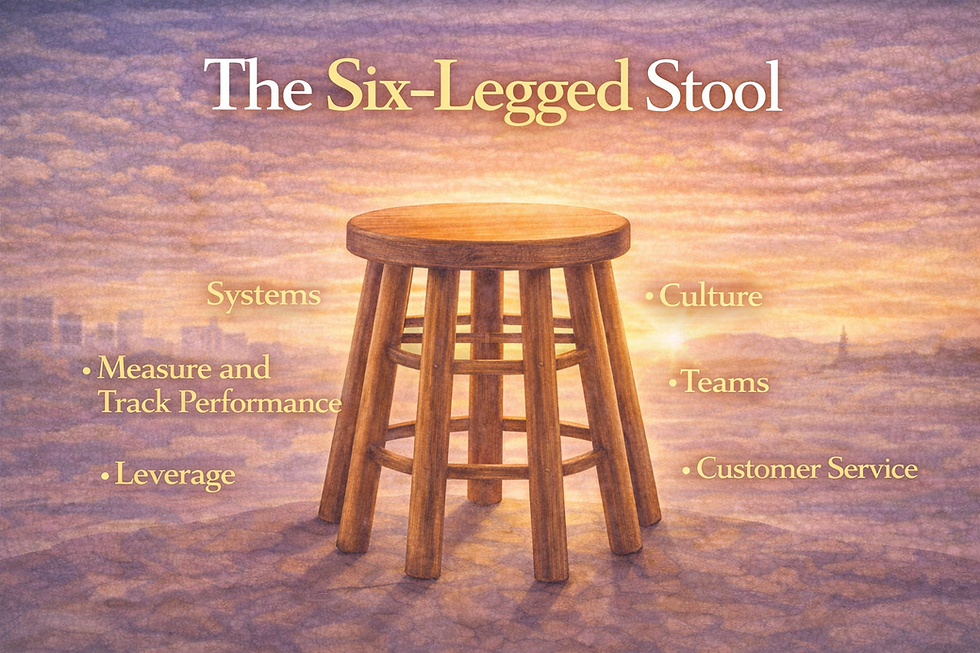
Here's a framework to use to think about business health — what you actually need to assess when doing periodic reviews.
Think of the core principles of a well-run business as a six-legged stool. The legs are:
Systems
Measure and Track Performance
Leverage
Culture
Teams
Customer Service
Each leg matters. And here's the thing about a six-legged stool: if one leg is missing or too short, the whole thing becomes unstable. You might be able to balance on it — for a while — but it's always a little precarious. And the more weight you add (the more you try to scale), the more that the short leg becomes a problem.
This is why periodic assessments matter so much. Not to admire what's working — though that matters too — but to find the short leg before it becomes a crisis.
Most entrepreneurs are strong on some of these and thin on others. The ones who stay in the 'working in the business' trap are usually avoiding the legs they haven't built yet. The culture conversation feels too soft. The performance tracking feels too corporate. Building systems feels too slow.
The leg you've been avoiding is almost always the one that's keeping you stuck.
Which of those six areas are you strongest in right now? Which one have you been quietly avoiding? Be honest — the answer is usually obvious the moment you ask.
Part 5: The Tools That Actually Keep You on Track

I want to get specific here, because 'stay accountable' and 'do regular reviews' are easy things to nod at and then not do.
Here are the tools and structures that have actually worked for our businesses — and for the entrepreneurs I mentor.
Scheduled Assessments — On the Calendar, Non-Negotiable
The single most important thing you can do is put your assessments on the calendar before you need them — not when you find time. Quarterly is a good rhythm for most businesses. Semi-annual if quarterly feels like too much. What matters is that it's scheduled, it has an agenda, and it actually happens.
At a minimum, sit down every quarter and ask: What worked? What didn't? What do we need to correct? What are the next steps? Those four questions, applied honestly and consistently, will do more for your business than almost any other habit.
Benchmarks — So You Know If You're Moving
A goal without a benchmark is just a wish. You need to know, specifically, what progress looks like — and you need to check it regularly enough to correct before you're too far off course.
This doesn't have to be elaborate. A simple dashboard of your most important numbers — revenue, customer acquisition, retention, whatever your business lives and dies on — reviewed weekly or monthly, is enough to tell you whether the ship is on course.
What gets measured gets managed. We've lived this. The moment you start tracking something consistently, your behavior around it changes. Not because you're forced to — but because the data makes the reality undeniable.
Accountability Partners, Coaches, and Mastermind Groups
There is a difference between a coach and a mentor. A coach can teach you. A mentor has done it themselves.
Both have value. But what I've found — both in our own journey and in my work with entrepreneurs — is that the accountability relationship matters more than the format. Whether it's a formal coach, a mastermind group, a trusted peer, or an advisory board, you need someone who knows your goals, tracks your progress, and has permission to tell you the truth.
When we had our advisory board at HVI, there was an implicit agreement: we would come prepared, we would be honest about what wasn't working, and we would listen. That agreement held us to a standard we might have let slide if we were only accountable to ourselves.
Is there someone in your life right now who has full visibility into your business goals — and who will genuinely hold you to them? If not, what's one step you could take this week to create that relationship?
Calendar Reminders — Simpler Than You Think
Here is the lowest-tech version of all of this, and it works:
Set a recurring calendar reminder, right now, for the last week of every quarter. Title it 'Business Assessment.' Block at least two hours. Treat it like an appointment with your most important client — because in a sense, it is.
You will be amazed at how much this one habit changes. Not because magic happens in those hours. But because having the appointment forces you to prepare for it, and preparing forces you to actually look at where you are.
Part 6: The Why Behind the Work

I want to close this section the way I close every serious business conversation — by coming back to the reason any of this matters.
I ask every student the same question before I teach them a single tactic:
What is your WHY? What really motivates you, from your heart, to do what you are doing?
For us, the answer was always the life we wanted to build. Alaska and Hawaii — the two places dearest to our hearts — homes in both. The boat that sat on a trailer for years while the business consumed us, that eventually became a beautiful yacht. The travel. The time with our daughters and grandchildren. The ability to share what we'd built with the people we loved most.
None of that happened accidentally. We had those conversations deliberately, early in our marriage. We named the dream. We set our sights on it. And then, year after year, we made decisions that moved us toward it — even when the daily demands of the business pulled in every other direction.
That's what staying on course really means. Not just tracking your revenue targets or hitting your quarterly KPIs — though those matter. It means regularly reconnecting with why you built this thing in the first place, and making sure the business you're building is still pointed at the life you actually want.
You need to know where you want to be for all of this to make sense. Clarity is not just a business tool. It's a life compass.
The assessments. The benchmarks. The accountability. The course corrections. They all serve one purpose: to make sure that when you finally look up from the work — years from now — you find yourself somewhere close to where you meant to go.
That's Livin' the Dream. Not just a tagline. A commitment.
This Week's Exercise: Schedule Your First Assessment
One thing. This week. That's all I'm asking.
Open your calendar right now and block at least two hours in the next two weeks for a business assessment. Not someday. Not when things slow down. Now.
When you get there, bring these questions:
What is working well — and why?
What is not working — and what's the real reason?
What is the destination, my dream for my life?
Am I still pointed at the destination I desire?
What is the one correction I need to make right now?
That's the whole exercise. Two hours. Five questions. Honest answers.
And if you do this every quarter — consistently, without skipping it when things get busy — your business will look dramatically different in a year. Not because anything dramatic happened. Because you kept making small corrections, every quarter, before small problems became expensive ones.
Capable captains don't wait for the storm to check their heading. They check it while the water is still calm.
Podcast Spotlight

Gratitude Geek Podcast with Kandas Rodarte
I recently joined Kandas Rodarte on the Gratitude Geek Podcast to share my founder journey—from feeling stuck in the day-to-day to building systems that allowed us to step back and eventually sell our Alaska–Hawaii airline to Alaska Airlines.
We talked about why profit matters more than revenue, how simple systems help you duplicate yourself, and how even solopreneurs can build a “team” through smart delegation and leverage. It’s a powerful conversation about moving from operator to owner and creating a business that doesn’t depend on you for everything.
🎙️ Listen here: 313: Ral West on Building, Systematizing, and Selling Her Travel Business to Alaska Airlines
Final Thoughts
The dream doesn't drift all at once.
It drifts one skipped assessment at a time. One deferred conversation. One quarter where you were too busy to look up. One year where the business kept running, but you stopped steering.
The good news is this: course corrections don't require dramatic overhauls. They require consistency. A few hours every quarter. A handful of honest questions. People around you who tell you the truth.
That's the whole strategy. It's not complicated. But it requires you to actually do it — not just understand it.
So, go schedule the assessment. Reconnect with your why. Check the heading.
The dream is still out there. Make sure you're still sailing toward it.
Take 3 minutes to find out how much of a bottleneck you are in your own business. See the link to my Owner Diagnostic below. |
Watch our latest videos on YouTube:
Know someone who could benefit? Share this with them!


It was lovely to host you on Gratitude Geek. Thank you for sharing your amazing story!